Training in response to the urgent need for fast-growing professions
While some professions seem to stand the test of time by constantly evolving, others are emerging and booming. One of the distinctive features of these new professions is that they require new skills as quickly as possible. Consequently, there is a pressing need for large-scale, rapid training in these sectors, which are experiencing labor shortages. The difficulty lies in addressing both of these constraints simultaneously. Faced with this need for transformation, we quickly come up against the limitations of traditional teaching models. NITID.Skills aims to address this issue by finding a solution to quickly and effectively train new players in these sectors. The idea is to activate the levers of desire, encourage action, and promote immersion. In particular, technology does not replace humans, but rather amplifies their actions.
One mission: to make training desirable and effective
We are driven by the conviction that knowledge is better retained when it is experienced firsthand. The era of lectures, where knowledge is imparted from above without any connection to reality, is over. That is why we place experience at the heart of the learning process. Each learner becomes an active participant in their own journey, immersed in real-life situations that stimulate their curiosity, motivation, and desire to succeed. This active teaching method is based on the idea that success depends not only on the knowledge acquired, but also on the pleasure of learning and the confidence to apply it. To achieve this, we have chosen to use technology. It becomes a powerful lever for engagement. In fact, it allows learners to experiment, make mistakes, and progress without fear. Whether virtual or augmented reality, these tools do not replace human training; they extend it and make it more desirable.
A three-step method for transforming learning
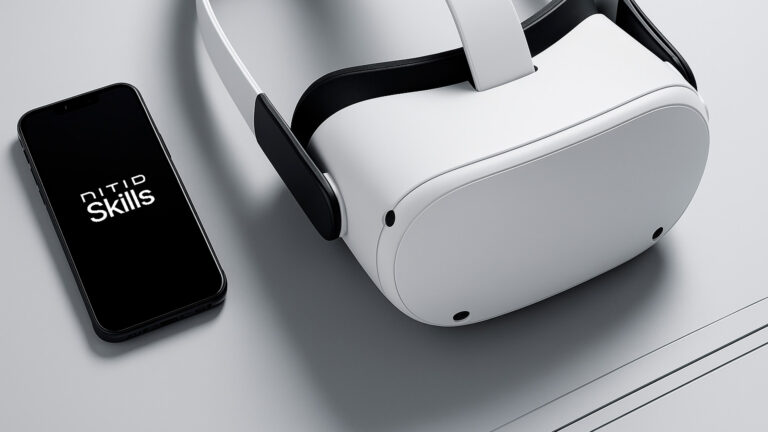
At NITID.SKILLS, to meet the training needs of fast-growing professions, we have divided the course into three distinct stages. First, there is the initial training, where VR allows learners to immerse themselves in practice. Next comes physical training, where learners practice in a training center. Finally, there is continuing education, which, thanks to VR, not only allows learners to maintain their knowledge, but also to enrich it with new developments.
The initial training phase: learning through virtual experience
We set the goal of completing this phase right away. For example, in the field of converting combustion engine cars to electric, it would be too time-consuming and costly to carry out this initial phase in person. Using a virtual reality headset, learners can immerse themselves in real-life situations and practice. This helps spark interest, contextualize knowledge, and break down the fear of failure. In this kind of environment, learners are free from the fear of being judged by others.
Furthermore, it should be noted that immersion in virtual reality allows learners to experience the profession before practicing it. Finally, this has the effect of building confidence and creating a strong emotional connection.
Physical training phase: learning through action and interaction
At this stage, we take things a step further by moving on to practical application in a real-world environment. Continuing with the example of converting our combustion engine car, this time the learner will learn in a workshop. Their task will be to convert several models in order to firmly establish their knowledge and gain dexterity. The upstream practice in VR will save them time during this phase. In this phase, we provide the learner with two types of support. First, through the presence of an expert trainer, and second, through the use of AR glasses. In this phase, we reinforce technical skills and human connection.
The continuing education phase: lifelong learning
Once the person transitions from learner to practitioner in this rapidly growing field, the task is not over. We have set up a continuing education program. The goal is to maintain skills over time and support changes in the profession. More specifically, the platform and VR effectively help learners review knowledge and integrate new trends or tools. In addition, remaining integrated into the training program creates a virtuous cycle of learning and adaptability.
An educational approach that supports talent and businesses
More broadly, this model offers the possibility of rapidly increasing the number of learners supported in order to meet the demands of fast-growing professions. Once implemented, it can be easily replicated without compromising the quality of teaching. For learners, it provides motivation, autonomy, and enhanced integration. On the other hand, for businesses, it ensures productivity, attractiveness, and retention of trained talent. It is a real tool for my employer brand.
Immersive training as an accelerator for the future
In short, at NITID.SKILLS, our mission is to provide training solutions for fast-growing professions. Examples include decarbonization of mobility, energy, and digital technology. In essence, our vision is to provide better, faster, and more engaging training.